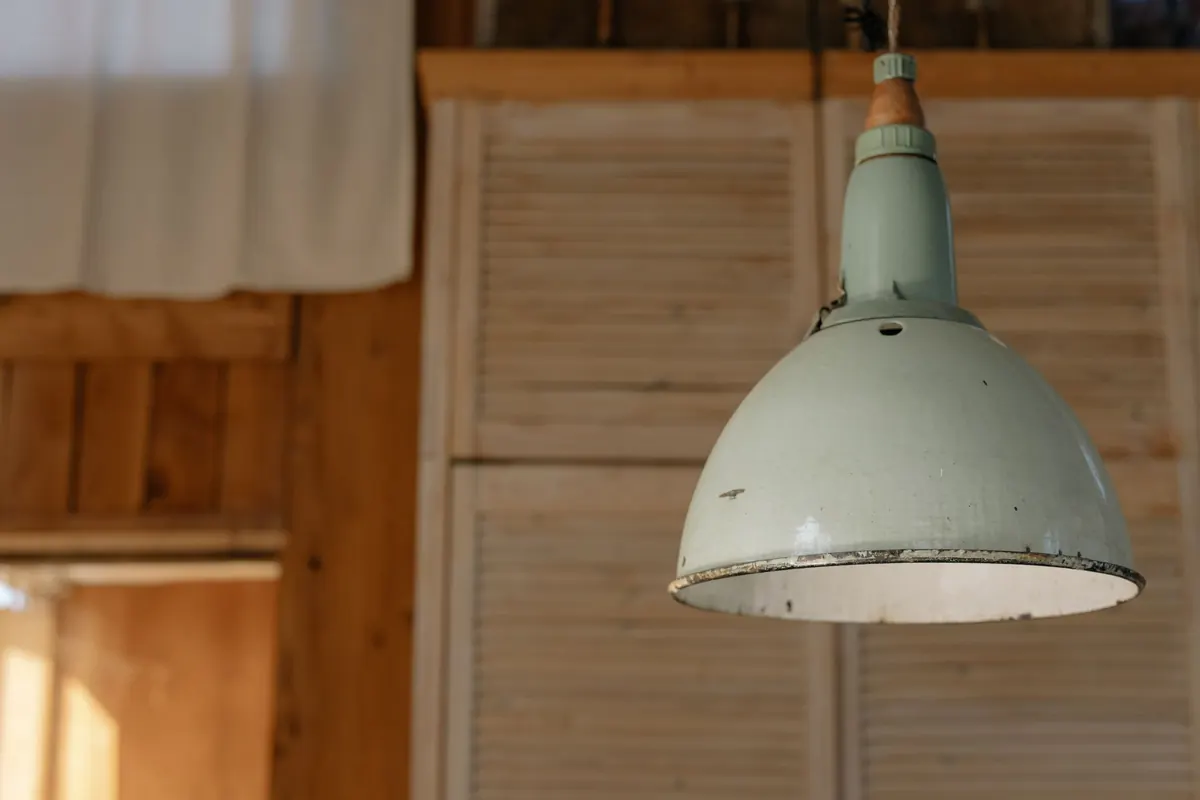
A lamp shade is the part of a light you look at every day, and it is usually the part people buy fastest. A linen drum in a warm oatmeal arrives, you set it on the lamp, and something is off: the shade swallows the socket, light fires straight into your eyes, or it simply will not attach. Fit problems are rarely mysterious. They come from a handful of details that take five minutes to check and are easy to skip.
Here is what to look at before you order, roughly in the order that matters.
Measuring the Wrong Thing
Shade listings give you three or four diameters and a height. Your lamp gives you one number that decides almost everything: the width across its widest point, usually the base or the fattest part of the body.
As a working rule, the bottom of the shade should be about as wide as that measurement, give or take an inch or two. Narrower and the lamp looks top-heavy and the bulb shows. Wider and the shade takes over the whole piece of furniture.
- Measure the widest part of the lamp base.
- Measure from the table to the bottom of the socket — the base height the shade has to balance against.
- Measure your current shade: bottom diameter, top diameter, and vertical height.
- Check the total height once assembled. On a bedside lamp, the top of the shade should sit below your eye level when you are sitting up in bed, or you will spend your reading time looking at the inside of the shade.
Measure the lamp, not the shade. Nearly every fit problem starts with the base width somebody never wrote down.
One more trap: on tapered shades, the listed height is often the slant height measured along the side, not the vertical drop from top to bottom. On a tall empire shade those differ by an inch or more, which is enough to change both the look of the lamp and whether a harp and bulb fit underneath.
Choosing the Wrong Fitter
Fitter is the term for how a shade attaches, and it is the most common reason a shade goes back in the box.
- Spider — a ring with arms that rests on top of a harp and is held down by the finial. Standard on most table and floor lamps.
- Uno — a threaded ring set inside the shade that screws onto the socket itself. Common on smaller lamps and vintage styles.
- Clip-on — small clips that grip the bulb directly, used on sconces and tiny accent lamps with no harp.
- Euro or socket ring — a threaded ring made for a European-style socket. It is not interchangeable with uno.
Spider and uno shades do not swap without parts. A spider shade needs a harp installed on the lamp; an uno shade usually needs the harp removed first. Harps cost very little and come in numbered heights, so when a shade sits too high or too low, a different harp is often the fix rather than a different shade. Finials are sold separately by thread size too — if the new one will not catch, replace it instead of forcing it. If a listing never mentions fitter type, ask before ordering.
Picking a Shape for Looks Alone
Shape controls where the light goes, and that matters more than the silhouette.
Drum and wide-bottomed empire shades spread light broadly, which suits a living room. A coolie cone, intended for floor lamps, throws light up and across the room; put that shape on a bedside table and you get glare. Shades with a narrower bottom push more light down onto a book or a work surface. Then there is opacity: an opaque or dark-lined shade turns a lamp into a fixture that lights the ceiling and floor with only a soft glow at the sides, while translucent fabric or parchment lets more light through the material. Neither is better, but choosing the opposite of what you wanted shows up on the first evening.
Forgetting Bulbs, Dimmers, and Small Accessories
A shade can be perfect and still disappointing if the bulb underneath does not fit or the dimmer misbehaves.
- Bulb size and shape. A small top opening leaves little room. Wide globes and decorative bulbs can touch the fabric. Compare the bulb's widest point with the shade's interior clearance.
- Wattage rating. Every socket has a maximum wattage printed on or beside it. Stay at or below that figure, even with cooler-running LEDs.
- Dimming. A three-way socket needs a three-way bulb. A wall or in-line dimmer needs a bulb rated as dimmable, and many smart bulbs dislike being on a dimmer at all — check the pairing before you commit.
- Harps, risers, and extenders. These correct height and fitter mismatches and cost a fraction of a new shade.
A note worth taking seriously: swapping a bulb or a shade is a job anyone can do. Rewiring a lamp, replacing a socket, or adding a dimmer to older wiring is not. Have a qualified electrician look at that work.
Buying Pairs and Shades You Can't Return
Pairs are the quiet trap. Fabric is cut and dyed in batches, so two "identical" shades ordered weeks apart can read slightly different in tone, and the gap is obvious when the lamps sit on the same console. Order both at once, from the same listing. Small hardware details count too: a brass finial on a nickel lamp reads as a mistake every time you walk past it.
Because
Photo: cottonbro studio / Pexels